
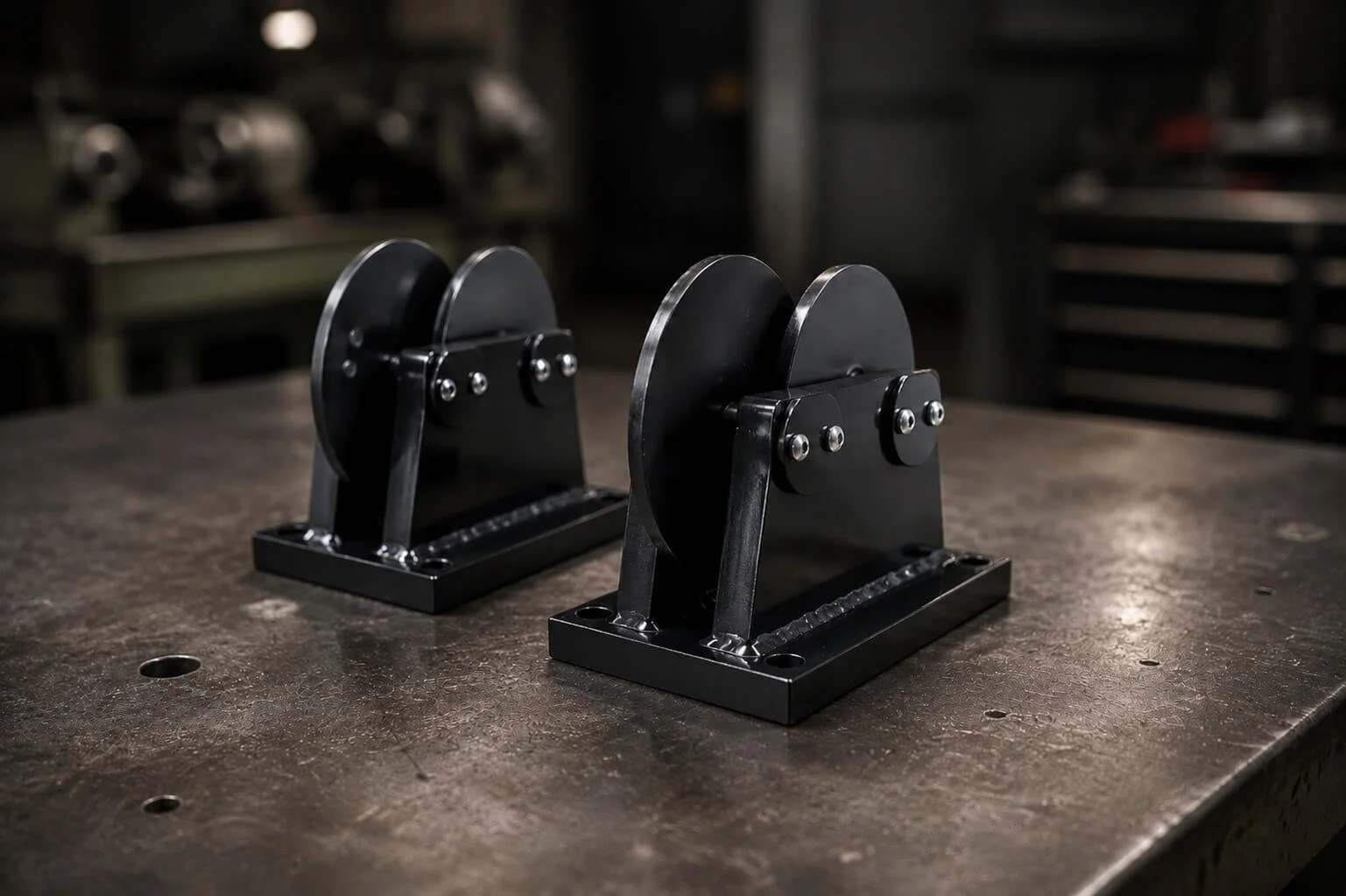
Static Balancing Ways for Precision Industrial Applications
Anderson Static Balancers Are Now Part of LTL Machining
LTL Machining has acquired the Anderson Static Balancing Ways product line. The same precision-engineered balancing ways you’ve relied on for years are now manufactured, supported, and sold by LTL Machining, ensuring continuity, quality, and excellent customer service.
What Are Static Balancing Ways?
Static balancers are precision tools used to detect and correct imbalance in rotating parts such as grinding wheels, pump impellers, boat and airplane propellers, fans, flywheels, crankshafts, and other rotating components. They work by allowing parts to rotate freely under the force of gravity.
By minimizing friction and drag, balancing ways clearly reveal heavy points in a part, making it possible to add or remove weight until balance is achieved.
Why Choose Anderson Static Balancing Ways by LTL Machining
Precision is built into every Anderson static balancer. Proudly made in the USA, our balancing ways carry forward the advanced engineering and expert craftsmanship dating back to Anderson Brothers Manufacturing, assuring accuracy that stands up to years of use.
Each balancing way features rotating alloy steel discs and spindles that are ground and polished to precise tolerances. Spindles and bushings are hardened to guarantee long service life, even when balancing heavy parts. Disc perimeters are induction hardened and ground to provide a hard, smooth surface for detecting out-of-balance conditions
Our Micro Precision static balancers (MP-20 and MP-1) use narrow, precision-ground, hardened knife-edge discs with through-holes in the sides of the discs to reduce disc weight and increase sensitivity. The maximum weight capacity is 250 lbs.
Balancing Way Frame Styles
Pillow Block Static BalancERS
Pillow Block models are well suited for balancing long or oversized parts. The balancing ways can be set at any distance apart, allowing flexibility based on part length and geometry.
Depending on the application, frames may be mounted on a raised stand to provide the necessary space for part rotation.
A-Frame Static BalancERS
A-Frame models provide a stable platform for balancing a wide range of rotating parts. Cross shafts hold the frames upright while allowing sufficient clearance for part rotation on the balancing way.
A-Frame balancing ways are commonly used for:
Fan balancing
Rotor balancing
Crankshaft balancing
Flywheel balancing
Impeller balancing
Propeller balancing
Grinding wheel balancing
Many other rotating parts
How Static Balancing Works
Anderson Static Balancing Ways by LTL are ready to use right out of the box.
Since gravity always exerts its force straight down, the balancing way itself does not need to be level, nor are centers required to position the part. The principle of static balancing is to allow the part to rotate freely, with the balancing way adding minimal friction and drag.
To balance a part:
Place the part, or its arbor, so it is cradled by the precision discs
Gently rotate the part
Gravity will then accurately indicate an out-of-balance condition by causing the heavy point on the part to stop at the bottom of the rotation.
Weight can be added or material removed until the part stops rotating in random positions
This process quickly and accurately indicates whether a part is balanced or unbalanced.
Common Applications for Static Balancing
Anderson Static Balancing Ways are used across a wide range of industrial balancing applications, including:
Shaft balancing
Driveshaft balancing
Crankshaft balancing
Fan and blower balancing
Rotor balancing
Impeller balancing
Grinding wheel balancing
Flywheel balancing
Why Precision Balancing Matters
Out-of-balance rotating components can cause vibration, instability, poor surface finishes, and premature wear in machines and tooling. Precision static balancing helps:
Improve part quality and surface finish
Reduce vibration and chatter
Extend the life of grinding wheels, spindles, and machinery
Lower maintenance and operating costs
Improve consistency and reliability in production
Proper balancing becomes increasingly critical as rotational speeds increase.
Find the Right Balancing Way for Your Application
Choosing the correct balancing way depends on:
Part diameter and weight
Length and geometry of the component
Required sensitivity and accuracy
Frame style and mounting needs
Balancing Way Capacity, Dimensions, and Specifications
Balancing ways are available in multiple configurations and capacity ranges to accommodate different part sizes and weights.
Detailed dimensions and specifications—particularly for pillow block balancing ways—are available to help engineers and machinists select the correct setup for their application.
Need Help Selecting the Right Balancing Way?
If you have any questions about selecting the appropriate balancing way for your application, the LTL Machining team is here to help.